
Siemens SIMATIC S7-300 vs. S7-1500: Key Differences and Migration Path
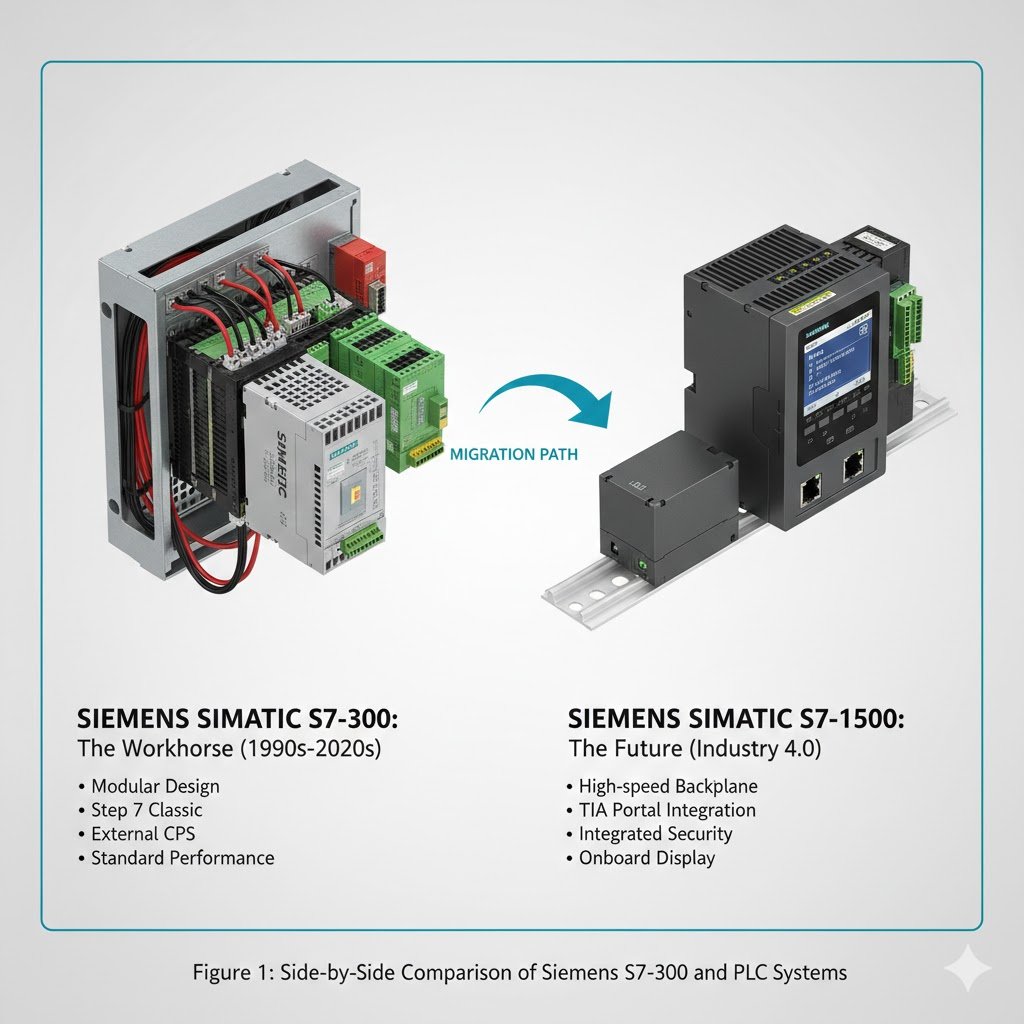
For decades, the Siemens S7-300 has been the workhorse of global manufacturing. However, with the push toward digitalization and Industry 4.0, the S7-1500 has emerged as the new standard for high-end automation. Understanding the core differences is essential for engineers planning system upgrades or new installations.
Performance and Processing Power
The S7-1500 is not just a replacement; it is a generational leap. Built on a much faster backplane bus and high-speed processors, it offers significantly lower command execution times compared to the S7-300.
- S7-300: Designed for standard control tasks with a modular bus system that has served the industry well since the 1990s.
- S7-1500: Features a high-speed internal backplane and advanced motion control integration as standard, making it ideal for complex, synchronized high-speed applications.
Hardware and Integration
While the S7-300 relies on an external front connector and often requires additional modules for advanced networking, the S7-1500 integrates these features directly into its design.
| Feature | S7-300 | S7-1500 |
|---|---|---|
| Display | LED Diagnostic only | Integrated Onboard Color Display |
| Networking | External CP modules often needed | Integrated PROFINET (Multiple ports) |
| Bus Speed | Standard Backplane | High-speed Backplane (400 Mbit/s) |
Software and Engineering
The engineering environment is perhaps the most significant shift. The S7-300 was primarily programmed using Step 7 Classic, whereas the S7-1500 is optimized for the TIA Portal (Totally Integrated Automation).
TIA Portal provides a more intuitive interface, integrated security features, and superior symbolic programming capabilities. For maintenance teams sourcing replacement parts for either system, reliable hardware can be found at edv-automation.com to ensure minimal downtime during migration.
Why Migrate Now?
Siemens has officially moved the S7-300 into the "Product Discontinuation" phase in many markets. The S7-1500 offers:
- Integrated Security: Protection against unauthorized changes and copy protection for intellectual property.
- Advanced Diagnostics: Faults are shown in plain text on the CPU display, reducing troubleshooting time.
- Efficiency: Significant reduction in engineering time through the use of standardized libraries in TIA Portal.
Conclusion
The S7-300 remains a legendary PLC, but the S7-1500 is the future. For existing facilities, a phased migration is often the most cost-effective approach. Whether you are maintaining a legacy S7-300 rack or commissioning a new S7-1500 system, utilizing genuine Siemens automation components is the only way to guarantee long-term stability.